Crossing Into Stillness: What Japanese Temple Threshold Rituals Reveal About the Art of Sacred Transition
The Problem With Walking Straight In
In contemporary American life, transitions are rarely honored. We move from a tense conference call directly into a family dinner. We collapse into bed still mentally rehearsing the day's unfinished business. We arrive at a place of worship already distracted, or step away from meditation only to immediately reach for our phones. The passage between states of being—between effort and rest, noise and quiet, obligation and presence—has been compressed to nearly nothing.
This is not simply a matter of poor scheduling. It reflects a deeper cultural assumption: that what matters is the destination, and that the space between destinations is wasted time.
Japanese temple architecture disagrees, profoundly and beautifully.
The Liminal Architecture of Sacred Space
At temples across Japan—from the grand complexes of Kyoto to the moss-draped mountain sanctuaries of rural prefectures—the approach to the sacred is never abrupt. Visitors do not simply open a door and find themselves before the altar. Instead, they are led through a deliberate succession of thresholds, each one designed to strip away a layer of the ordinary self.
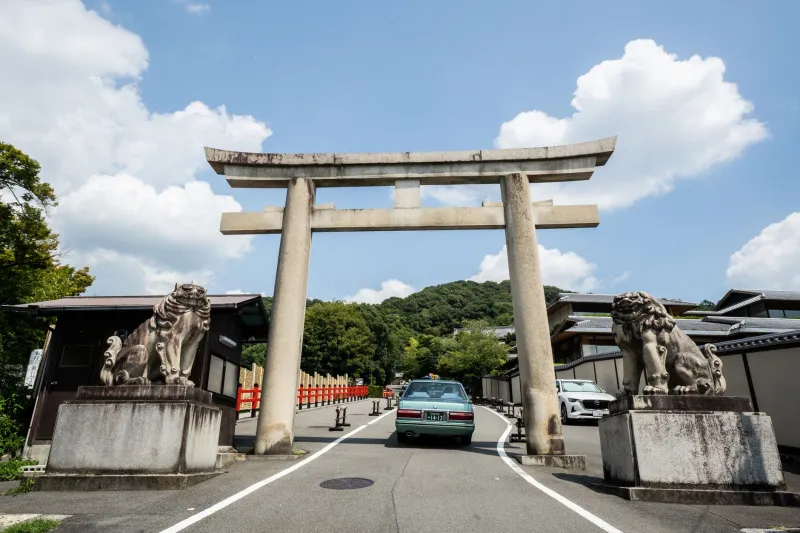
The journey typically begins at the sanmon, the main gate, often flanked by fierce guardian figures whose role is not merely decorative. Their presence signals that the visitor is leaving the unremarkable world behind and entering a space governed by different principles. The act of stepping through the gate is itself a small ceremony—a physical acknowledgment that something is changing.
Beyond the gate, the path often winds rather than proceeds directly, a design choice that is intentional rather than incidental. The winding approach slows the body, and in slowing the body, it begins to slow the mind.
Then comes the temizuya, the stone purification basin filled with clear water. Here, visitors ladle water over each hand in a prescribed sequence, a ritual that serves purposes both hygienic and deeply symbolic. The act of washing is not merely cleansing; it is a form of declaration. It says: I am setting aside what I was carrying. I am preparing to receive.
Only after these successive passages does the visitor arrive at the main hall. And by that point, something has genuinely shifted. The architecture has done its quiet work.
What the Threshold Understands That We Have Forgotten
The wisdom embedded in this sequence is psychological as much as spiritual. Modern neuroscience would recognize in these rituals what researchers call "transition markers"—deliberate cues that signal the brain to shift between modes of engagement. Without such markers, the mind struggles to fully release one context before entering another. We carry our email inbox into our living rooms. We bring Monday morning into Sunday evening.
Japanese temple design understood this long before the language of neuroscience existed. The gate, the winding path, the purification basin, the threshold crossing—each element functions as a cue, gently but firmly redirecting attention and intention.
At Koumarusan Hourinji, this understanding sits at the heart of how sacred space has long been conceived: not as a room one enters, but as a condition one is gradually brought into.
Translating the Temple Threshold Into American Daily Life
The practical implications for modern American households and routines are more accessible than they might initially appear. One need not construct a stone basin in the entryway or install guardian statues at the front door—though both have their appeal. What matters is the principle: the deliberate creation of transitional rituals that mark meaningful shifts in the shape of the day.
The returning ritual. Many Japanese households maintain the custom of pausing at the entryway upon returning home, removing shoes and briefly acknowledging the shift from the outer world to the inner one. This pause need not be prolonged. Even thirty seconds of stillness at the threshold—a conscious breath, a quiet intention to leave the workday behind—can serve as a genuine reset. The key is consistency. The ritual must be practiced daily to accumulate its full effect.
The purification gesture. The temizuya tradition need not be reproduced literally, but its spirit can be honored. Washing hands deliberately upon arriving home, or upon sitting down to a meal, transforms a routine act into a small ceremony. The water becomes a cue. The hands become the instrument of transition.
The winding approach. Consider redesigning how you move through significant transitions in your day. Rather than stepping directly from a Zoom call into lunch, build in a brief walk—even within your own home or office building. Physical movement along a chosen path, undertaken with some degree of mindfulness, mimics the winding approach to the temple hall. The body's passage through space becomes a form of mental preparation.
The threshold pause. Before entering any space where a different quality of presence is desired—a bedroom, a meditation corner, a dining room set for a meaningful meal—pause at the doorway. A single breath, taken with awareness of what you are leaving and what you are entering, is enough. Over time, this pause accumulates into genuine habit, and the threshold itself begins to carry meaning.
The Ending Is Also a Beginning
One aspect of Japanese temple ritual that is easily overlooked is its attention to departure as much as arrival. Leaving a sacred space is not merely walking back out the way one came. There is often a quality of gratitude and closure to the exit—a final bow, a moment of acknowledgment before the gate recedes behind the visitor.
This attention to endings is equally applicable to modern life. The way we conclude a period of work, a conversation, or a family gathering shapes what we carry forward from it. A deliberate ending—even something as simple as closing a notebook, extinguishing a candle, or speaking a quiet word of thanks before leaving a room—teaches the mind that this particular chapter has closed. What follows can then begin cleanly.
Reclaiming the Space Between
The great gift of the Japanese temple threshold tradition is not its specific forms, but its underlying conviction: that the space between things is not empty. It is, in fact, where transformation happens. The moment before the prayer. The breath before the meal. The pause before the reply.
In a culture that has largely abandoned the art of transition, recovering even a modest version of this wisdom can be quietly revolutionary. Not every doorway needs to become a gateway to the sacred. But some of them might. And the ones that do will change the quality of everything that lies on the other side.