Sacred and Unfinished: How Japanese Temples Use Incompletion as a Spiritual Teaching
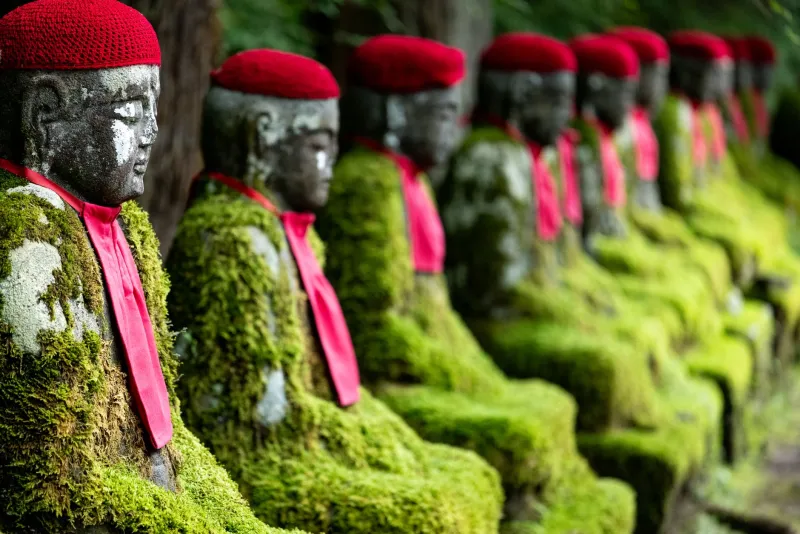
There is a statue in a mountain temple in Japan that has stood for centuries with one arm uncarved. Pilgrims travel long distances to sit before it. They do not come despite the incompletion. They come, in part, because of it.
This is not an anomaly in Japanese sacred tradition. It is, in many ways, the point.
American culture has developed a complicated and often punishing relationship with the unfinished. We speak of "loose ends" as problems to be solved, of "unresolved" matters as wounds to be closed. Self-help shelves in every bookstore promise closure, completion, and the satisfaction of finally arriving at wherever it is we believe we are meant to be. The unfinished project, the abandoned goal, the chapter that never reached its intended conclusion — these are framed as failures of will, discipline, or character.
Japanese temple tradition, refined across more than a millennium of spiritual practice, holds a strikingly different view.
Fukinsei: The Principle That Changes Everything
Within the aesthetic and philosophical vocabulary of Japanese culture, the concept of fukinsei — often translated as asymmetry or irregularity — points toward something far more expansive than mere visual preference. It is one of the foundational principles underlying Zen aesthetics, and it carries a spiritual weight that Western audiences rarely encounter through design alone.
Fukinsei is not the accidental asymmetry of carelessness. It is the deliberate introduction of incompletion into a work, a space, or a practice as an acknowledgment of a fundamental truth: that wholeness, in the absolute sense, belongs to no created thing. The universe itself is in motion. To present a finished, perfectly symmetrical object as the highest expression of beauty or wisdom would be, in the temple tradition, a kind of lie.
Where kintsugi — the practice of repairing broken pottery with gold — teaches that damage can be transformed into beauty, fukinsei goes a step further. It suggests that the crack, the gap, the unresolved space, need not have been broken at all. It was always meant to remain open.
What the Temple Builders Understood
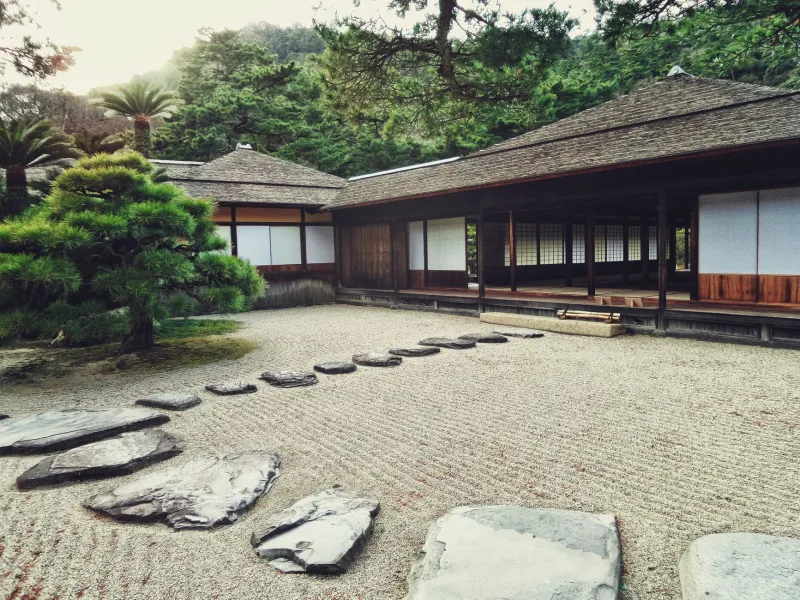
The deliberate incompletion found in Japanese sacred art is not confined to sculpture. It appears in the raked gravel of dry gardens, where a single stone is placed just slightly off-center. It surfaces in the architecture of temple gates, where a single bracket may be left unfinished or a roofline allowed a subtle irregularity. It appears in ink paintings where the brush lifts before the circle closes.
These choices are pedagogical. They are, in the truest sense, teaching tools.
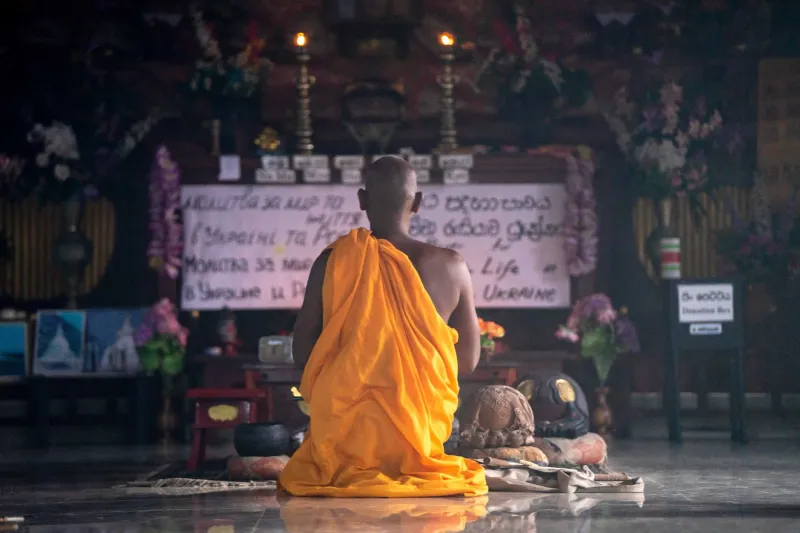
The monk who meditates before an unfinished image is not being asked to imagine what the completed version might look like. He is being invited to sit with the discomfort of incompletion itself — to notice the mind's reflexive reach toward resolution, and to observe what happens when that reach is gently refused. The unfinished work becomes a mirror for the practitioner's own restlessness.
In this way, the temple transforms incompletion from a problem into a practice.
The American Perfectionism Problem
To bring this teaching into a contemporary American context requires some honest accounting. The United States has built much of its cultural mythology around completion: the finished product, the achieved dream, the triumphant ending. From the pioneer narrative of westward expansion to the modern startup culture of Silicon Valley, the arc bends toward resolution. Anything less is considered provisional, a work in progress, something to be apologized for or hidden.
The psychological cost of this orientation is substantial. Research consistently shows that Americans report disproportionate shame around unmet goals, unfinished projects, and life chapters that did not conclude as planned. The divorce that was supposed to be a marriage. The career that pivoted unexpectedly. The novel that sits at chapter seven. The spiritual practice that was taken up and set down and taken up again.
These are not failures. According to the philosophical tradition housed in Japan's oldest temple halls, they may be among the most honest things about us.
Reframing the Unresolved
The invitation extended by fukinsei is not passive resignation. It does not counsel abandonment or indifference. Rather, it asks for a fundamental shift in how we interpret the open-ended dimensions of our lives.
Consider the meditation practitioner who has struggled for years with a wandering mind, convinced that a truly advanced practitioner would have achieved some permanent stillness by now. Or the person who has carried unresolved grief for a parent who died without reconciliation, treating that unresolved feeling as evidence of emotional incompetence. Or the professional who left a career midway through what everyone expected to be a linear trajectory, and has quietly carried the weight of that perceived abandonment ever since.
Fukinsei does not ask these individuals to feel good about their incompletion. It asks something more nuanced: to regard the open space not as a wound but as a threshold. In Japanese temple tradition, the unfinished is not the opposite of the sacred. It is frequently where the sacred lives.
Bringing This Practice Into Daily Life
For those drawn to incorporating this philosophy into their own spiritual or contemplative lives, the practice need not be abstract.
One approach, drawn loosely from Zen aesthetic practice, involves deliberately leaving one element of a creative or devotional project intentionally incomplete. This might mean a home altar arrangement with one empty space that is never filled. It might mean a journal entry that ends mid-thought, as a reminder that the thought continues beyond the page. It might mean allowing a room to remain slightly asymmetrical, a single cushion turned at an angle, a shelf with one open gap — not from laziness, but from intention.
The practice is not in the object. It is in the quality of attention you bring each time you encounter it. Does the incompletion still produce anxiety? Has it begun to feel neutral? Has it, with time, begun to feel like breathing room?
This is the arc the temple tradition traces — not from broken to whole, but from discomfort with openness to a kind of ease within it.
The Uncarved Space as Invitation
There is a phrase sometimes attributed to Taoist thought, though it echoes through the corridors of Japanese spiritual practice as well: wu wei, the wisdom of non-doing, the power of the space that is not filled.
The uncarved arm of that mountain statue is not waiting to be completed. It is complete in its incompletion. It holds a question that no finished answer could contain.
For Americans accustomed to measuring spiritual progress in milestones and accomplishments, this may be the most challenging and the most liberating teaching that Japanese temple tradition offers. Your unfinished life is not a problem awaiting solution. It is, if you can learn to receive it as such, a teaching — patient, enduring, and as old as the stone it was carved from.
The crack is not where you fell short. It is where the light enters, and where, if you are willing to sit quietly enough, the teaching begins.