What Stones and Streams Are Saying: Decoding the Spiritual Vocabulary of Japanese Temple Gardens
Walk through the grounds of a traditional Japanese temple—Ryōan-ji in Kyoto, or the moss-carpeted paths of Saihō-ji—and you may sense that something is communicating with you, though you cannot immediately say what. The sensation is not accidental. For more than a thousand years, Buddhist and Shinto temple communities across Japan have constructed their outdoor spaces as deliberate spiritual texts, composed not in syllables but in stone, water, moss, and negative space. Every placement carries intention. Every view from a particular threshold was designed to arrive in the visitor's awareness at precisely the right moment.
For American readers accustomed to gardens organized around aesthetics or utility—a bed of annuals here, a vegetable plot there—the Japanese temple garden offers something far more demanding and far more rewarding: the idea that outdoor space can be a teacher.
The Garden as Sacred Narrative
In the Buddhist traditions that shaped so much of Japan's landscape design, the physical world was never understood as merely decorative. Nature, properly observed, was a mirror of impermanence, interdependence, and the possibility of awakening. Temple gardens were constructed as environments in which that teaching could be experienced rather than simply heard.
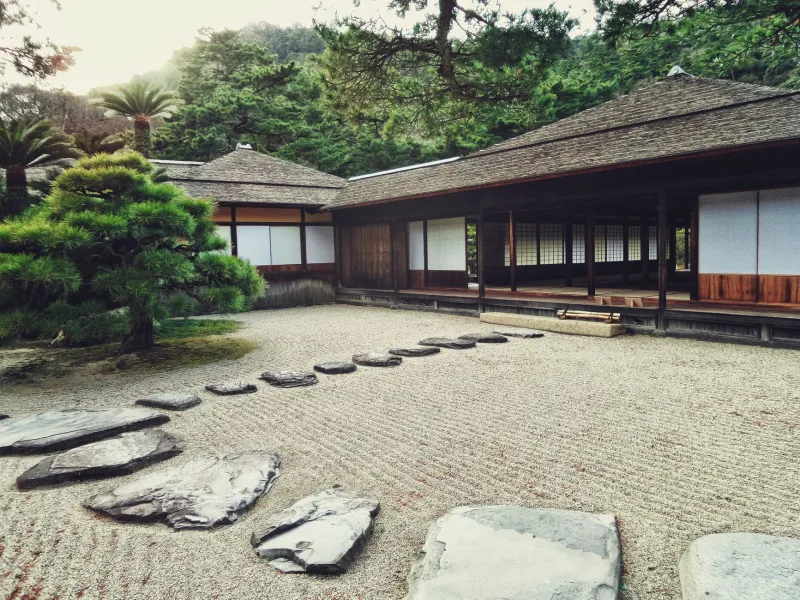
The famous karesansui, or dry rock garden, is perhaps the most internationally recognized expression of this philosophy. At Ryōan-ji, fifteen stones are arranged across raked white gravel in a composition from which no single vantage point allows you to see all fifteen simultaneously. This is not an oversight. It is a precise statement about the limits of human perception—a reminder, encoded in granite and sand, that complete understanding will always lie just beyond our grasp. The garden does not explain this. It makes you feel it.
Larger stroll gardens—the kind found at temples like Kenroku-en or Kokedera—operate through a different but equally deliberate grammar. As the visitor moves along a winding path, successive views unfold in a carefully choreographed sequence. A stone lantern glimpsed through bamboo. A pond that appears suddenly after a curve in the trail. A single gnarled pine framing a distant hillside. Each scene is staged to arrive with the emotional weight of a sentence in a longer argument, guiding the visitor through states of contemplation, surprise, tranquility, and eventually a kind of wordless clarity.
Reading the Elements
To begin understanding this language, it helps to know something of its primary vocabulary.
Stone is perhaps the most fundamental element. In Japanese spiritual thought, stones carry a quality called iwakura—the sense of a divine presence dwelling within or near them. Large upright stones often represent mountains or the enduring nature of truth. Flat stones invite the visitor to pause. Stones placed in groupings of three frequently echo the Buddhist trinity or the Shinto concept of mitsu, the sacred number of completion. When you encounter a prominent stone in a temple garden, it is rarely there simply because it was heavy and convenient to place.
Water speaks of time, purification, and the movement of mind. Still water—a mirror pond reflecting the sky—invites inward contemplation and suggests the quality of mizu no kokoro, a mind like still water, undisturbed and clear. Moving water, whether a stream threading through mossy banks or a thin waterfall over black stone, represents the continuous flow of life and the Zen principle that clinging to any moment is futile. The sound of water in a Japanese temple garden is as carefully considered as its visual form; the shishi-odoshi, the bamboo water feature that fills and tips with a hollow knock, was originally designed not as decoration but as a rhythmic prompt to return wandering attention to the present.
Plants are chosen and shaped with equal precision. Moss signals age, patience, and the slow accumulation of spiritual practice—qualities that cannot be rushed. Pine trees, with their resilience through winter, have long represented steadfastness and longevity. Pruned into asymmetrical, reaching forms, they embody wabi, the beauty of the irregular and the incomplete. Seasonal flowering plants—cherry in spring, maple in autumn—introduce the teaching of mono no aware, the bittersweet awareness that beauty and life are transient. Their presence is not incidental; it is a scheduled reminder.
Empty space may be the most counterintuitive element for Western eyes. In a culture that tends to equate fullness with abundance, the deliberate openness of a Japanese garden—the expanse of raked gravel, the bare margin around a single stone—can initially feel unfinished. But this emptiness is ma, the sacred interval that gives meaning to what surrounds it. Without the silence between notes, there is no music. Without the open ground, the stone has nowhere to speak from.
Bringing the Language Home
You need not recreate Ryōan-ji in your backyard to begin practicing this way of thinking about outdoor space. The principles are scalable and surprisingly adaptable to American environments, whether you are working with a suburban yard in the Pacific Northwest, a rooftop terrace in Chicago, or a single container garden on an apartment balcony in New York City.
Begin by choosing one element with deliberate intention rather than decorative impulse. A single large stone, placed where you will see it from your most-used window, can function as a daily anchor for attention—a material reminder that stillness exists even when your mind does not. Choose a stone that genuinely interests you, one with texture or weight that commands a second look.
Consider your relationship with water. A small recirculating fountain positioned so that its sound reaches your morning sitting area can serve the same contemplative function as a temple stream. The key is placement that makes the water audible but not intrusive—present enough to draw the mind gently back, quiet enough to invite rather than demand.
Pay attention to the path through your outdoor space. In Japanese garden design, the path is never purely functional; it determines the sequence of experience. If your current garden offers only one view, consider whether a simple curve, a stepping stone that requires a slight detour, might introduce the element of unfolding—the sense that the space reveals itself to you rather than presenting everything at once.
Finally, practice leaving something out. Resist the impulse to fill every corner. The margin you preserve around a single well-chosen plant or stone is not emptiness. It is the condition in which that element can be truly seen.
A Garden That Teaches Rather Than Performs
The deepest aspiration of the Japanese temple garden is not beauty in the conventional sense—though beauty is often present—but awakening. These spaces were built by communities of practitioners who understood that the environment shapes the mind, and that a mind shaped by impermanence, simplicity, and careful attention is more capable of genuine peace.
For Americans navigating lives of relentless stimulation, the invitation embedded in this tradition is both ancient and urgently practical. Your outdoor space—however modest—need not be a stage for seasonal performance or a catalog of horticultural achievement. It can be, if you choose, a quiet teacher: patient, non-verbal, and always ready when you are.