The Wisdom in Your Hands: Ancient Japanese Craft Practices as a Path Back to Stillness
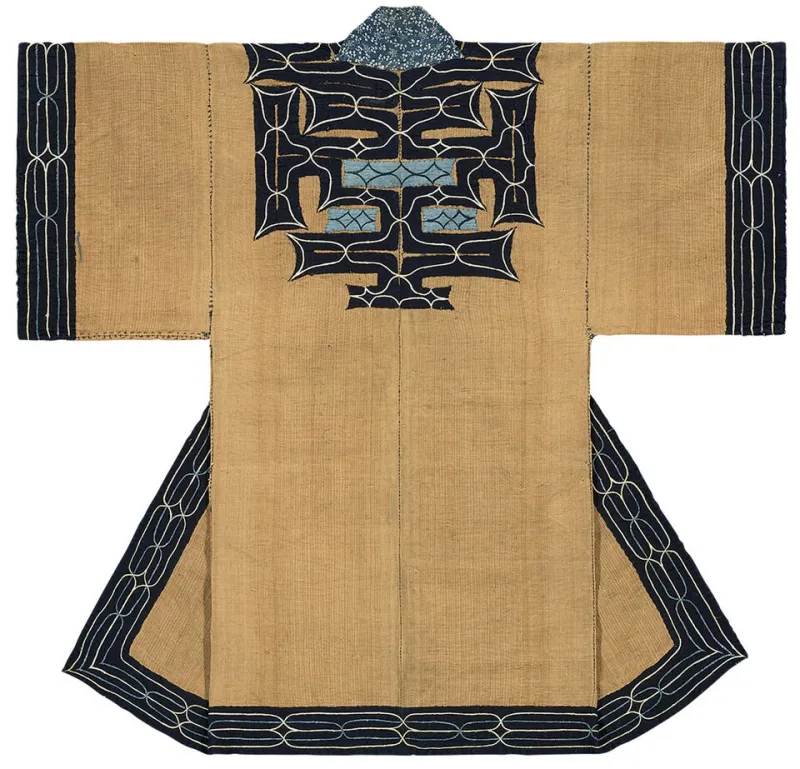
Photo: Unknown Ainu artisan. Published in Hali magazine, Public domain, via Wikimedia Commons
Somewhere in the gap between the last email you answered and the next meeting you have to prepare for, your hands are waiting. They are, neurologically speaking, among the most sophisticated instruments you possess—richly mapped in the brain's sensory cortex, capable of extraordinary subtlety, and almost entirely underemployed by the knowledge economy in which most Americans now spend their working lives. A Japanese indigo dyer in the Tokushima region would find this a peculiar form of impoverishment. For such a craftsperson, the hands are not merely tools. They are the primary organ of spiritual attention.
This understanding—that manual craft is a form of contemplative discipline—runs deep in Japanese aesthetic and religious culture. It is not a metaphor. The traditions of aizome (indigo dyeing), nawa (rope-making), urushi (lacquerwork), and dozens of related practices were developed within communities where the boundaries between artisanal skill and spiritual cultivation were deliberately maintained as permeable. To master a craft was to cultivate a quality of mind. The object produced was, in a sense, secondary.
The Spiritual Logic of Repetitive Work
Western productivity culture has a complicated relationship with repetition. We tend to treat it as something to be automated away, a sign that a task has not yet been optimized. Japanese craft traditions hold the opposite view. In the philosophy that underlies practices like chado (the tea ceremony) or shodo (calligraphy), repetition is precisely the point. It is through the thousandth repetition of a gesture—the same fold, the same stroke, the same immersion of cloth into a dye vat—that the practitioner begins to release the analytical mind and access something quieter beneath it.
Neuroscience has begun to describe this phenomenon in its own vocabulary. Research published in journals including Frontiers in Psychology has documented that repetitive fine motor tasks can induce states measurably similar to those produced by formal meditation: reduced cortisol levels, decreased activity in the default mode network (the brain's "mind-wandering" system), and increased present-moment awareness. What Japanese artisans have practiced for generations, contemporary researchers are only now articulating in clinical terms.
For the American professional whose mental life is dominated by abstraction—spreadsheets, strategies, digital communication—this offers a genuinely different kind of relief than another wellness app can provide.
Aizome: The Indigo Vat as Contemplative Space
Of all traditional Japanese craft practices, aizome—the art of dyeing with natural indigo—may offer the richest entry point for those drawn to its spiritual dimensions. The process is, by any modern standard, unhurried. The dye vat must be cultivated like a living thing, fed with nutrients, kept at precise temperatures, and tended with daily attention over weeks before it is ready to receive cloth. The dyer develops a relationship with the vat that practitioners describe in terms that sound less like chemistry and more like kinship.
The dyeing itself is physical and rhythmic. Cloth is submerged, moved through the liquid with slow, deliberate strokes, then lifted into the air where oxidation transforms the yellow-green of fresh indigo into the deep blue the tradition is known for. This cycle—immersion, movement, emergence, transformation—is repeated many times across a single session. There is no rushing it. The color deepens only through patient repetition.
Several American craft studios and Japanese cultural centers, particularly on the West Coast, now offer introductory aizome workshops. Participants frequently report a quality of absorption they had not anticipated—a suspension of ordinary mental chatter that bears a striking resemblance to descriptions of meditative states. The hands know what to do; the mind, for once, is permitted to follow rather than lead.
Nawa: The Meditative Art of Rope
Less visually dramatic but perhaps equally profound, traditional Japanese rope-making (nawa) carries its own contemplative history. Natural fiber rope has been integral to Japanese life for millennia—used in agriculture, architecture, and, in sacred contexts, as the shimenawa rope that marks the boundary between ordinary and sacred space at Shinto shrines. To encounter a thick shimenawa hanging at a shrine gate is to meet an object that carries spiritual significance not only through its placement but through the act of its making.
The craft of twisting and braiding natural fibers—rice straw, hemp, jute—is inherently rhythmic. The hands develop a pattern; the body finds a tempo. Like aizome, nawa work resists acceleration. The material itself sets the pace, and the practitioner must learn to follow it. This surrender of control to the logic of the material is, in Japanese craft philosophy, understood as a form of humility—a recognition that the craftsperson is in relationship with something larger than their own intention.
For American workers accustomed to environments in which speed and output are the primary metrics of value, this inversion can be quietly radical.
The Maker Movement's Unacknowledged Ancestor
The contemporary American maker movement—with its enthusiasm for handmade goods, artisanal production, and craft as counter-cultural statement—has spiritual roots it does not always acknowledge. The Japanese concept of monozukuri (the art and spirit of making things) offers a philosophical framework that goes considerably deeper than aesthetic preference or economic positioning.
Monozukuri holds that the quality of attention brought to the making of an object is inseparable from the quality of the object itself. This is not mysticism; it is craft philosophy grounded in centuries of observation. A lacquer bowl made by a distracted artisan and one made by a focused one may appear identical to the casual eye, but practitioners insist the difference is perceptible—in the hand, in the way light moves across the surface, in some quality that resists easy description.
What this tradition offers the stressed American professional is not a new hobby but a different relationship to work itself: one in which the process holds value independent of the product, and in which the quality of one's inner state is understood as a legitimate dimension of any task.
Beginning Where You Are
You need not travel to Kyoto or enroll in a years-long apprenticeship to begin exploring this tradition. The principles underlying Japanese craft practice are accessible through any manual activity pursued with genuine attention: bread-making, woodworking, hand-sewing, even careful gardening. The key is not the specific craft but the quality of presence brought to it.
Choose one activity that involves your hands and natural materials. Commit to it without distraction for thirty minutes—no podcast, no background television. Notice the texture of what you are working with. Allow the rhythm of the task to set your pace rather than imposing your own urgency upon it. When the mind wanders, return attention to the sensation in your fingertips.
This is, in essence, what Japanese craft traditions have always taught: that the path to stillness runs directly through the hands, and that the objects we make with full attention become, in some quiet way, vessels of the peace we brought to their making.
At Koumarusan Hourinji, we hold that ancient wisdom does not demand historical distance to remain alive. The intelligence embedded in these craft traditions is available now, in your kitchen, your workshop, or your kitchen table—waiting, as your hands have always been, for your full attention.