Gilded Fractures: What the Ancient Practice of Kintsugi Teaches Us About Living Whole
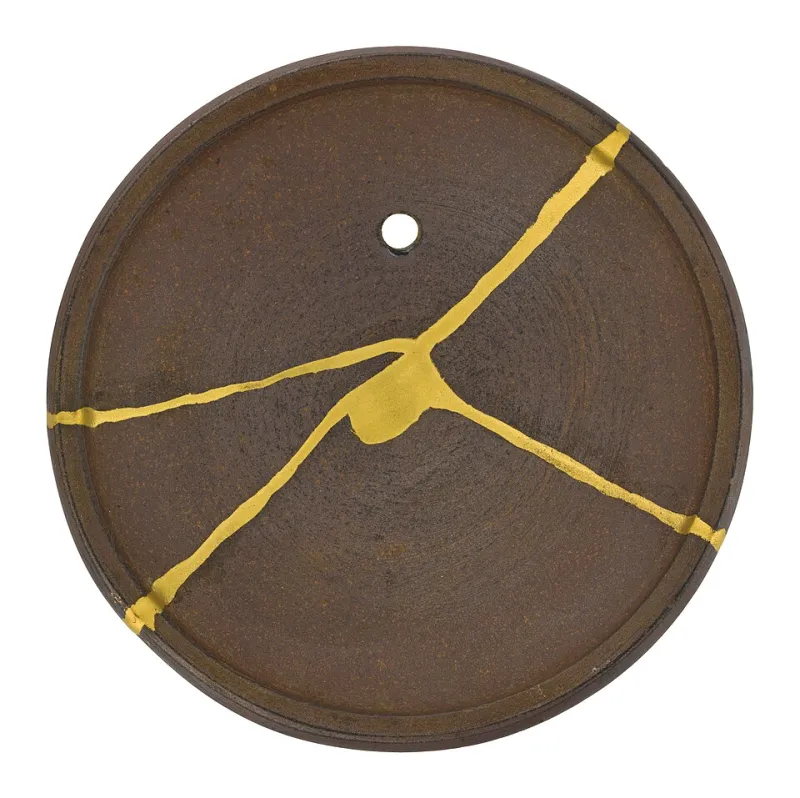
Photo: D-Kuru, CC BY-SA 4.0, via Wikimedia Commons
There is a particular kind of grief that comes from dropping something irreplaceable. The moment of impact, the scatter of shards across the kitchen floor, the sudden and terrible understanding that the object will never be what it was. In America, the instinct is nearly universal: sweep it up, throw it away, and order a replacement by Thursday. We are, after all, a culture built on the next new thing.
But in Japan, there exists a tradition that interrupts this impulse entirely. Kintsugi — translated literally as "golden joinery" — is the centuries-old practice of repairing broken ceramics not by hiding the damage, but by filling the cracks with lacquer mixed with powdered gold, silver, or platinum. The result is an object that is, in a very real sense, more beautiful for having been broken. The fracture lines do not disappear. They shine.
At Koumarusan Hourinji, we believe this ancient wisdom speaks directly to something the modern American soul is quietly starving for.
The Philosophy Behind the Gold
Kintsugi is thought to have emerged during the Muromachi period, roughly the late 15th century, though its philosophical underpinnings draw from much older currents in Japanese thought — particularly the Buddhist concepts of impermanence and the Zen aesthetic of wabi-sabi, which finds dignity and even elegance in the transient and the imperfect.
The central premise is disarmingly simple: breakage is part of an object's history, not a reason for shame or concealment. By repairing with gold rather than attempting an invisible mend, the craftsperson acknowledges what happened and transforms it into something worthy of attention. The bowl that shattered and was made whole again carries more story, more meaning, than the one that has never known damage.
This is not mere aesthetics. It is a statement about the nature of value itself.
A Countercultural Act in the Age of Perfection
Consider the environment most Americans navigate daily. Social media presents curated highlight reels. Corporate culture rewards the appearance of seamless competence. Advertising exists almost entirely to convince us that we are insufficient — that the right purchase will finally complete us. Cosmetic surgery, image filters, strategic LinkedIn profiles: the machinery of modern life is largely devoted to the erasure of visible imperfection.
Against this backdrop, kintsugi is quietly radical. It proposes that the effort to conceal damage is itself a kind of diminishment — that in hiding our fractures, we deny the fullness of our experience and, paradoxically, make ourselves less whole.
This is not a call to wallow in hardship or perform suffering for public consumption. Rather, it is an invitation to stop spending energy on the pretense that difficulty never found us.
Applying Kintsugi to Relationships
Perhaps nowhere does this philosophy find more immediate relevance than in the realm of human connection. American culture tends toward a binary understanding of relationships: they are either intact or they are over. A friendship fractured by betrayal, a marriage strained by loss, a family bond tested by years of distance — these are often treated as things to be either perfectly restored to their original state or quietly discarded.
Kintsugi suggests a third path. A relationship that has survived rupture and been repaired with honesty, patience, and deliberate care is not a lesser version of what it was. It is something different — something that now carries the gold of that difficult work within it. The repair is visible. It is also, in its own way, luminous.
This requires a willingness to acknowledge that the break happened, to name it rather than paper over it. That kind of honesty is uncomfortable. It is also, according to this tradition, the only way to create something genuinely durable.
The Career That Did Not Go as Planned
For many Americans, professional identity is deeply entangled with self-worth. A layoff, a failed business, a pivot forced by circumstance — these events carry a particular sting precisely because we have been taught to read our career trajectories as measures of our fundamental adequacy.
Kintsugi reframes this entirely. The professional setback, seen through this lens, is not a blemish to be minimized on a résumé or explained away in interviews. It is a line of experience that, integrated honestly, can become a source of genuine insight and even authority. The entrepreneur who built something that failed and then built again has something the unbroken success story does not: they know exactly where the fracture lines run, and they have learned to work with them.
This is not optimistic spin. It is a fundamentally different ontology — a way of understanding what professional experience is actually for.
Bringing Kintsugi Into Your Home and Practice
For those moved to engage with kintsugi in its literal form, beginner kits are now widely available through Japanese import retailers and craft suppliers across the United States. Many community studios in cities including Portland, Chicago, and New York now offer kintsugi workshops, often facilitated by practitioners trained in traditional Japanese methods.
But the practice need not be ceramic to be meaningful. Consider keeping a journal specifically dedicated to documenting repairs — not just physical ones, but moments of reconciliation, course corrections, and hard-won recoveries. Place objects you have mended, however imperfectly, in visible locations in your home rather than hiding them away. Let them serve as daily reminders that survival and beauty are not mutually exclusive.
In the tradition of many Japanese spiritual practices, the physical act and the interior shift are understood to reinforce one another. You do not need to believe in the philosophy first. You need only begin.
The Gold Was Always There
Kintsugi does not pretend that breaking is painless, or that every fracture heals cleanly. What it offers instead is a different question to ask in the aftermath of damage. Not how do I make this look like it never happened? but rather how do I honor what this has been, and what it might yet become?
In a nation that has always prided itself on reinvention, this ancient Japanese practice offers something genuinely new: the suggestion that reinvention need not mean erasure. That the most enduring transformations are the ones that carry their history forward — not hidden beneath the surface, but running through the center, bright as gold.